 This month’s featured bulk herb of the month is not an herb, but a member of Kingdom Fungi: Lion’s mane mushroom! You can now find lion’s mane powder in our bulk herb jars (along with several other dried mushrooms, including chaga, chanterelles, cordyceps, crimini, porcini, reishi, and shiitake).
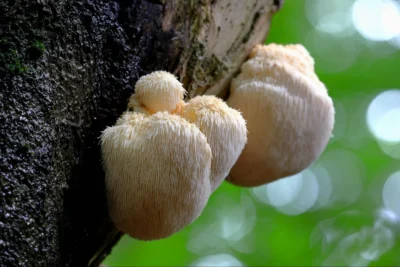
Lion’s mane (Hericium erinaceus) is named for its fruiting bodies, which grow in clumps on dead or dying hardwood trees with white icicle-like spines. These mushrooms grow worldwide in the Northern Hemisphere, and in Asian countries such as Korea, Japan, China, and India, they have been used for cooking and as medicine for centuries. In Japan, this mushroom is known as Yamabushitake, which roughly translates to “Mountain-Priest Mushroom,” because its fruiting bodies are said to resemble a garment worn by the Shungendō sect of Buddhist monks. In China, lion’s mane is known as Hóu Tóu Gū (monkey’s head mushroom) and Shishigashira (lion’s head).
Health Benefits of Lion’s Mane
Lion’s mane has grown in popularity for its potential to improve a variety of health outcomes, from brain and nerve health to digestive and heart health. This highly nutritious mushroom has anti-inflammatory properties and contains probiotics, vitamins such as thiamine, riboflavin, and niacin, minerals like manganese, zinc, and potassium, and several other beneficial compounds.
One of lion’s mane’s biggest claims to fame is its potential to improve brain health, cognitive function, and memory and focus. It contains compounds that stimulate the production of nerve growth factor (NGF), which helps grow and repair brain cells. While more research on humans is needed, this suggests that it could be helpful for healing traumatic brain injuries such as strokes. Though scientific studies on humans have been limited, some studies have shown that lion’s mane may improve cognitive function.
A 2008 double-blind study comparing a group of 15 Japanese adults that took 250mg of lion’s mane powder three times a day for 16 weeks and a group of 15 others that took a placebo for the same duration demonstrated the potential for lion’s mane to help improve cognitive function. The group who took the lion’s mane scored significantly higher on cognitive tests than the placebo group, and their scores even went down four weeks after they stopped taking the supplement.
The anti-inflammatory and antioxidant properties of lion’s mane have been shown in lab research to help reduce inflammation and the oxidative damage to cells. This can help symptoms caused by conditions that may result from chronic inflammation, such as heart disease, rheumatoid arthritis, and even cancers.
The probiotics in lion’s mane promote a healthy balance of gut flora, supporting the digestive system, which is largely linked to the immune system. These probiotics also prevent the growth of a bacteria called H. pylori, which can cause stomach ulcers. The possibility of lion’s mane to help treat stomach ulcers has been shown to be promising, but evidence in human subjects is limited.
How to Use Lion’s Mane Powder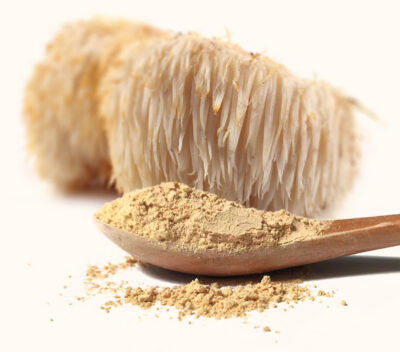
Lion’s mane powder is extremely versatile. With little to very mild taste, it can be added to both sweet and savory dishes, beverages, and baked goods. Try adding some to your smoothies, hot drinks, cereals, soups, and stews, and sprinkle into your cooking. Mushroom powders can add an umami boost to dishes without lots of sodium or other unhealthy ingredients.
Find lion’s mane powder in our bulk herbs department (listed alphabetically under “Mushrooms, Lion’s Mane Powder”).