
In honor of Mental Health Awareness Month, our featured bulk herb of the month for May is passionflower (Passiflora incarnata). This calming herb is commonly used for adults and children alike to help settle the mind and body.
Botanical Description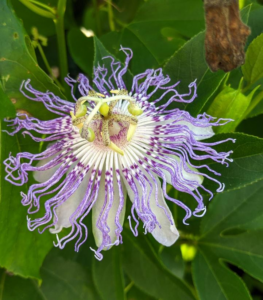
Passionflower is native to the southeastern United States and Central and South America, and is one of over 550 species in the Passiflora genus. (One such species, P. edulis, produces the tropical passionfruit that is commonly eaten as a fruit and in smoothies, juices, and desserts.) This perennial vine grows showy flowers that may be white, pink, purple, or blue and coiling tendrils that support its climbing habit.
Historical & Traditional Use
Upon “discovering” this plant in Peru in the 1500s, Spanish colonists likened this climbing vine’s large, showy flowers to the Passion of the Christ, thus giving it its common name. The three stigmas represented the “nails of crucifixion,” the frilly coronal filaments were the “crown of thorns,” the five stamens were the wounds, and the ten sepals were representative of ten of the disciples (Judas and Peter got left out due to their overall poor behavior). The Spanish missionaries used the flower to tell the story of Christ to indigenous peoples.
A Spanish doctor working in Peru named Nicolas Monardes was the first European to bring passionflower to Europe after learning of its medicinal uses from the Indigenous peoples of South America in 1569. Subsequently, passionflower became widely cultivated and used in European folk medicine.
Many indigenous groups in North America have used several parts of passionflower plants for millenia. The roots, leaves, tendrils, and fruits were used for a variety of purposes, from beverages to food to topical poultices. Seeds that were thousands of years old have been found around Virginia, and early European settlers documented the Algonkian Indians eating the passionflower fruit.
Health Benefits of Passionflower
Energetically speaking, passionflower is slightly cooling and drying (though some herbalists consider it neutral). It has anxiolytic, sedative, antispasmodic, and analgesic properties, but it is most well known for its effect as a calming herb that can settle the mind and body.
Passionflower is classified as a nervine, a group of herbs that nourish and tone the nerves and balance the nervous system. This herb contains aromatic compounds that directly influence GABAergic neurotransmission, reducing nervous overactivity, bringing peace to the nervous system, facilitating a feeling of grounding and relaxation, and allowing one to function from a place of calm, regaining a sense of confidence and control.
Because of these effects, passionflower is often prescribed by herbalists for anxiety, particularly if the anxiety is accompanied by a racing heart (tachycardia), a spinning mind, or difficulties sleeping. Passionflower can also help with symptoms such as agitation, restlessness, spasms, neuralgic pain, headaches, palpitations, and feelings of panic.
A systematic review of literature on the use of passionflower in neuropsychiatric disorders from 2020 concluded that the anti-anxiety effect of passionflower is comparable to some anti-anxiety drugs (oxazepam and midazolam). The authors deemed passionflower a safe and effective treatment option in cases of anxiety and insomnia, and reducing stress reactivity.9
Passionflower can also be used to alleviate the nervous irritability that may come with weaning off of pharmaceutical sedatives, anti-anxiety medications, or drug and alcohol addictions. Its effect on the stress response also makes passionflower useful for treating heart palpitations, tachycardia, and high blood pressure as well.
Passionflower has a marked sedative effect, so it can be taken as a soothing bedtime herbal tea to help promote restful sleep that won’t leave the user feeling groggy the next day like many sedatives. It’s also gentle enough to be used during the day to help manage anxiety, as its sedative effect is gentler than that of other herbs like valerian and hops.
As an antispasmodic, passionflower can help calm the muscles in the respiratory system (to help soothe whooping cough or asthma, for example). In cases of indigestion or other stress-induced digestive symptoms, passionflower can also relax the muscles of the stomach and GI tract. It can also relax the muscles of the stomach and GI tract, easing tension in cases of indigestion or other stress-induced digestive symptoms such as flatulence or intestinal spasms.
 How to Use Passionflower
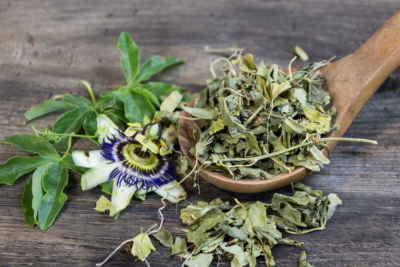
Herbalists most commonly use the dried aerial parts (flowers, stems, and leaves) of the passionflower plant. These parts can be used in several different plant preparations, including tea, tincture, or capsules. It is often used as part of a formula, as it combines well with other calming, stress reducing herbs and nervines such as skullcap, valerian, and chamomile.
Passionflower has a somewhat sour, slightly bitter, sweet taste. The sourness, not unlike the sourness of some other cooling nervines such as lemon balm, can be primarily perceived by the receptors on the sides of the tongue. The tea has a refreshingly smooth, rich texture that’s pleasant and easy to drink, and its deeply calming effects are often felt soon after ingestion.
To make an infusion/decoction of passionflower, add 1-2 tsp of dried herb to a mug of water, steeping for 15 minutes. After straining, drink passionflower tea up to three times a day.
Caution: Passionflower can increase the effects of some prescription medications for anxiety, so seek the guidance of a herbalist who will be able to advise on appropriate and safe dosing.
Find dried passionflower in our bulk herbs department.
- Janda K, Wojtkowska K, Jakubczyk K, Antoniewicz J, Skonieczna-Żydecka K. Passiflora incarnata in Neuropsychiatric Disorders—A Systematic Review. Nutrients. 2020; 12(12):3894. https://doi.org/10.3390/nu12123894.